
Strategies to Combat Executive Decision Fatigue
It’s 4 PM on a Thursday. You’ve answered a hundred emails, sat through three meetings, and approved four minor requests. Now, a simple question lands in your inbox: “Which stock photo should we use for the blog post?” You stare at the screen, completely unable to make a choice. It’s not a hard decision, but you’re out of mental gas. If this sounds familiar, you’re experiencing a well-documented phenomenon known as decision fatigue.
The typical advice—get more sleep, take a vacation—treats the symptom, not the cause. While personal recovery is important, it’s a temporary fix for a problem that regenerates the moment you log back on. The issue isn’t a personal failing; it’s a systemic one baked into your workflow. Truly effective strategies don’t focus on infinitely expanding your stamina but on reducing the number of low-impact decisions that land on your plate. Without a system to delegate and automate these choices, leaders inevitably become leadership bottlenecks, a primary driver of both personal burnout and team-wide frustration.
This guide moves beyond temporary relief to offer a more durable, organizational fix. The goal is to escape the cycle of constant approvals and reclaim your mental energy for the strategic work that only you can do by building a clear framework that empowers your team to act autonomously.
The Hidden Cost of Being the “Go-To” Person
Many leaders take pride in being the person with all the answers. If your team can’t move forward without your final approval on everything from an email subject line to a small expense, it feels like you’re essential. In reality, you’ve become a decision bottleneck. Every question sent your way forces your team to hit pause, creating a constant state of “hurry up and wait” that quietly kills momentum. This reliance doesn’t just exhaust you; it slows your entire operation down.
The reason this feels so draining is a concept called cognitive load. Think of your brain’s working memory like the RAM on a computer. Every decision you have to make—big or small—is another browser tab you have open. Answering an email, approving a design, and planning a meeting are all open tabs. When you have too many, the whole system slows down. Your brain, overloaded, struggles to process even simple requests, which is the very essence of decision fatigue.
This overload has a ripple effect. When your cognitive load is maxed out, you can’t give your team the quick, thoughtful answers they need. A simple sign-off that should take two minutes might sit in your inbox for hours because you don’t have the mental space to even open it. The bottleneck isn’t a character flaw; it’s a systemic problem where one person’s limited mental bandwidth becomes the speed limit for the entire team.
Ultimately, this cycle hurts everyone. You face burnout from the relentless demand, and your team members are prevented from taking ownership and growing their own judgment. Simply trying to “power through” is a losing battle. The solution isn’t about managing your personal stress better; it’s about redesigning the system so fewer decisions have to come to you in the first place.
Stop Draining Your Brain: An Introduction to “Decision Hygiene”
If powering through is a losing battle, what’s the winning strategy? The answer lies in practicing good Decision Hygiene. Just like personal hygiene involves small, regular habits that prevent illness, Decision Hygiene is a proactive system for keeping your team’s decision-making process clean and efficient. Instead of constantly reacting to every small request, you create a framework that stops the clutter from ever reaching you, freeing up your limited cognitive load for the work that only you can do.
This system is built on two core pillars that shift the burden of choice away from one person and distribute it intelligently across the team:
- Strategic Delegation: This isn’t just offloading tasks. It’s about formally distributing the authority to make specific types of decisions, empowering your team to act without asking for permission.
- Systematic Automation: This involves creating simple, pre-defined rules that allow routine decisions to make themselves, removing the need for human intervention entirely.
Embracing this approach replaces the constant stream of “Can you approve this?” interruptions with a predictable and empowering workflow. Your team gains the autonomy to solve problems, and you get back the time and mental energy to focus on strategy and growth. The key to making this practical is a simple tool for pre-making dozens of future decisions at once.
How to Pre-Make Decisions with a Simple “If/Then” Playbook
The most effective way to practice Decision Hygiene is to get decisions out of your head and into a shared system. This is where a simple “If/Then” playbook comes in. Think of it as a pre-written guide for your team that codifies how to respond to common, recurring situations, effectively automating routine business decisions before they ever demand your attention.
Every rule in your playbook has three essential parts. First is the trigger: the specific event that happens (If this occurs…). Second is the action: the clear, non-negotiable step to take (Then do this…). Finally, there’s the owner: the person or role responsible for executing the action. By defining these three elements, you remove all ambiguity and eliminate the need for someone to ask for permission.
For instance, imagine the constant requests for small refunds. A simple rule could be: If a customer requests a refund for less than $50, then the refund is automatically approved and processed, no questions asked. The owner is any customer service representative. Instantly, you’ve stopped dozens of future emails and Slack messages from ever being sent, empowering your team to solve customer problems on the spot.
This playbook isn’t about rigid control; it’s about creating clarity and autonomy. Each rule you add is another decision you no longer have to make, freeing up your mental bandwidth for bigger challenges.
Your Template for Building a “Decision Engineering Matrix”
That simple “If/Then” playbook we just discussed has a more formal name: the Decision Engineering Matrix. Don’t let the technical name intimidate you; it’s just a structured way to organize your pre-made decisions so your team can act with confidence and speed. Think of it as the official guide that turns your good intentions into a reliable, scalable system.
Creating your first matrix is a straightforward, three-step process. You don’t need special software, just a clear focus on reducing interruptions.
- Identify: Pinpoint a recurring, low-risk decision that frequently lands on your desk. Start with something small, like social media replies or minor expense approvals.
- Define: Create an unambiguous “If/Then” rule for that situation. The goal is zero guesswork for your team.
- Assign: Name a specific role (e.g., “any marketing associate”) as the owner responsible for executing the rule and communicate it clearly.
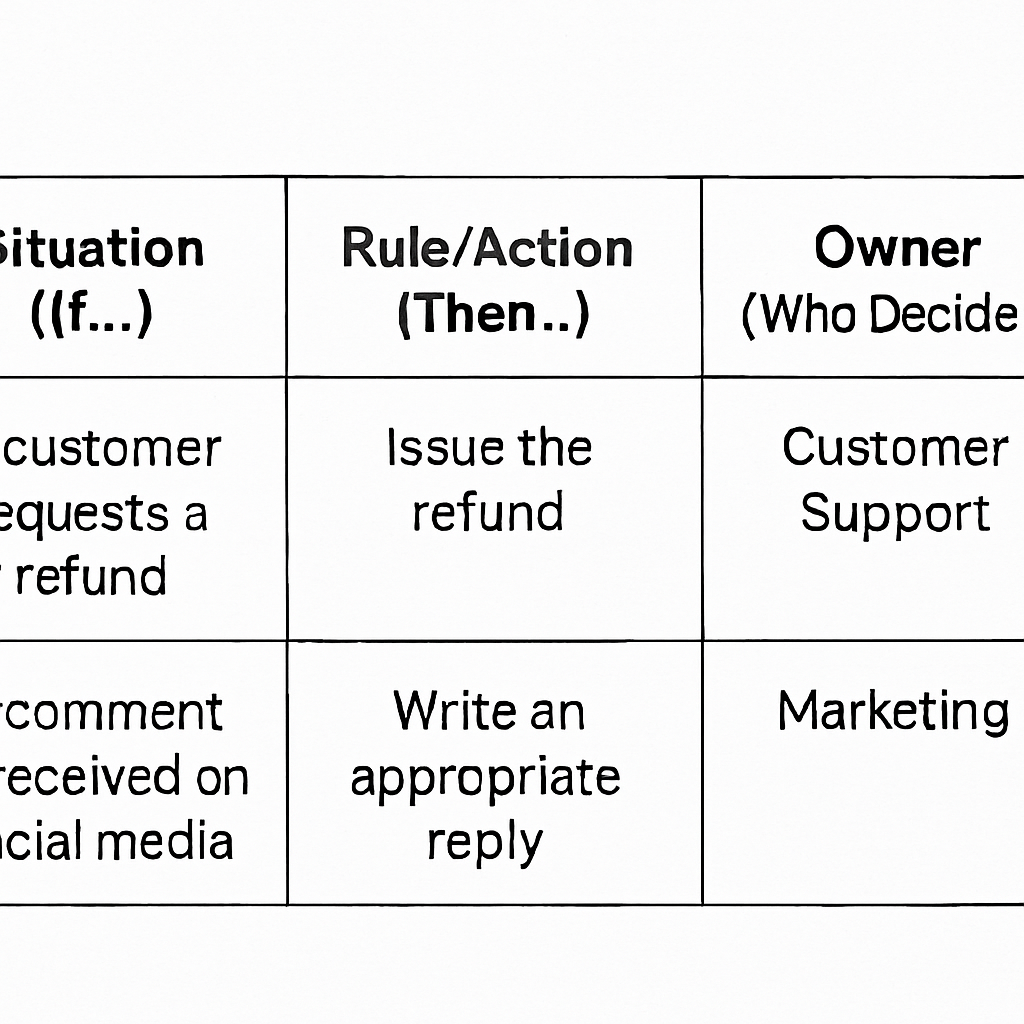
Your matrix can be a simple document or spreadsheet with three columns. Here is a basic decision engineering matrix template you can adapt, using the examples we’ve discussed.
| Situation (If…) | Rule/Action (Then…) | Owner (Who Decides) | | :— | :— | :— | | A customer requests a refund under $50. | Approve the refund immediately; no escalation needed. | Any Customer Service Rep | | A positive comment appears on a social media post. | Like the comment and reply with a “Thank You!” template. | Social Media Coordinator |
With this structure in place, you establish scalable decision making processes that empower your team and protect your focus. You’re no longer the answer key for every small question; you’re the architect of a system that runs itself.
3 Common Business Decisions You Can Systematize This Week
Knowing the structure of a Decision Engineering Matrix is one thing, but its power comes from identifying the right tasks to automate. The best candidates for your matrix share three traits: they are frequent, they are low-risk, and they can be guided by a clear, unambiguous rule. These are the small, repetitive choices that create constant interruptions but require very little strategic thinking.
By automating these routine business decisions, you can immediately reduce your cognitive load and improve team autonomy. Instead of waiting for your approval, your team can act. Here are three common examples you can implement this week:
- Social Media Engagement: Constant notifications for simple interactions drain focus.
- Rule: IF a comment is positive and contains no question, THEN the Social Media Coordinator can “like” it and move on. IF it’s a customer service issue, THEN they should tag the designated support team member immediately.
- Minor Expense Approvals: This is a classic administrative bottleneck.
- Rule: IF an expense report is under a pre-set limit (e.g., $75) and includes a valid receipt, THEN it is automatically approved by the team admin. No manager sign-off is needed.
- Routine Content Edits: Why hold up a document for a simple typo?
- Rule: IF a team member finds an obvious grammatical or spelling error in a draft, THEN they are empowered to fix it directly without seeking approval.
Each of these protocols establishes clear guardrails, allowing your team to handle day-to-day operations confidently. This not only frees up your schedule but also builds a more resilient and proactive culture.
The Real Payoff: A Faster Team and a More Strategic You
Implementing these simple rules does more than just clear your inbox; it fundamentally changes your team’s dynamic. Instead of a group of employees waiting for permission, you cultivate a team of problem-solvers. Improving team autonomy through clear protocols isn’t just a morale booster—it’s the engine for a more resilient organization where progress doesn’t hinge on a single person.
With team members empowered to make routine choices, the constant “stop-and-wait” cycle disappears. Decisions that once took hours of back-and-forth are now made in minutes, creating a powerful ripple effect. This is how you prevent leadership bottlenecks and build scalable decision-making processes, allowing your team’s momentum to build without you being the brake.
And what does this mean for your own schedule? The hours you once spent approving minor expenses or clarifying simple replies are now yours again. By offloading these low-impact decisions to a system, you reclaim the mental energy for the work that only you can do: planning for the future, mentoring your people, and solving the complex problems that actually move the needle.
This creates a virtuous cycle: an empowered team executes faster, which in turn frees you to think more strategically, making the entire operation smarter. This isn’t a distant corporate fantasy; it’s an achievable outcome for your team, and you can start seeing results almost immediately.
Your 3-Step Plan to Reclaim 5 Hours Next Week
You came here feeling the weight of endless decisions, likely thinking the answer was more personal effort. You now see that the most effective strategies to combat executive decision fatigue aren’t about you, but about the system you work in. You’re no longer just a decision-maker; you’re ready to become a decision architect.
So, how do you reduce executive decision fatigue starting tomorrow? Don’t try to overhaul everything at once. Instead, run a small, low-risk experiment to build a framework for autonomous decision making.
Here is your simple, one-week plan:
- Identify One Thing: Pick one, single repetitive decision that interrupts you most often.
- Draft the Rule: Write a clear, one-sentence “If/Then” rule for it.
- Launch & Learn: Share it with your team and run the experiment for one week.
This single rule does more than just clear one task off your plate. It proves a new possibility—a way to reclaim your focus for the big-picture challenges while empowering your team to act with confidence. You’re not just getting through the day; you’re designing a smarter way to win it.