
Build a Strategic Plan: Step-by-Step Guide
Do you ever feel like you’re running a business on a hamster wheel? You’re busy every single day, putting out fires and tackling urgent tasks, but at the end of the month, you’re not sure if you’ve actually moved forward. The problem isn’t a lack of effort; it’s the lack of a map. That map is your strategic plan, and it’s much simpler to create than you think.
Think of building your business like a road trip. Your strategy is the big-picture decision: “We’ll take the main highway for speed.” Your tactics are the specific, turn-by-turn directions: “Fill up with gas in Des Moines,” or “Book a hotel in Denver.” The most common trap is creating a glorified to-do list (tactics) and thinking it’s a strategy. This is why so much hard work can feel like you’re just driving in circles.
So where does a formal business plan vs a strategic plan fit in? Using our road trip analogy, the business plan is the detailed proposal you write to get a loan for the car—it proves the journey is viable to others. Your strategic plan, however, is your personal GPS. It’s the tool you use for operational planning, ensuring every action moves you closer to your final destination.
Step 1: Define Your Mission (Why) and Vision (Where)
Before you can map out a journey, you need two things: a compass that always points to your true north and a clear destination. In strategic planning, these are your mission and vision. Think of your mission as your “why.” It’s the core purpose behind everything you do, the reason you get out of bed in the morning. It’s not about making money; it’s about the change you want to create or the value you want to provide.
If your mission is your compass, your vision is the destination. It’s a vivid picture of what your business or project will look like when it’s succeeding in 3-5 years. A good vision statement is exciting and a little bit scary. It should describe a future that inspires you to act. For a local coffee shop, a vision might be “to be the community’s living room, where every neighbor feels at home.”
Don’t overthink it or try to sound corporate. The key is to answer two plain-English questions to find your direction.
- My mission is to… [your purpose/why you exist]
- My vision is for my project to look like… [a description of your ideal future in 3-5 years]
Having this clarity is one of the most powerful benefits of having a strategic vision. It’s not just a feel-good exercise; it’s a practical filter for every future decision. When a new opportunity arises, you can ask, “Does this move me closer to my destination?” If not, you have a clear reason to decline and maintain focus. Now that you know where you’re going, it’s time to get an honest look at where you are right now.
Step 2: Map Your Starting Point with a SWOT Analysis
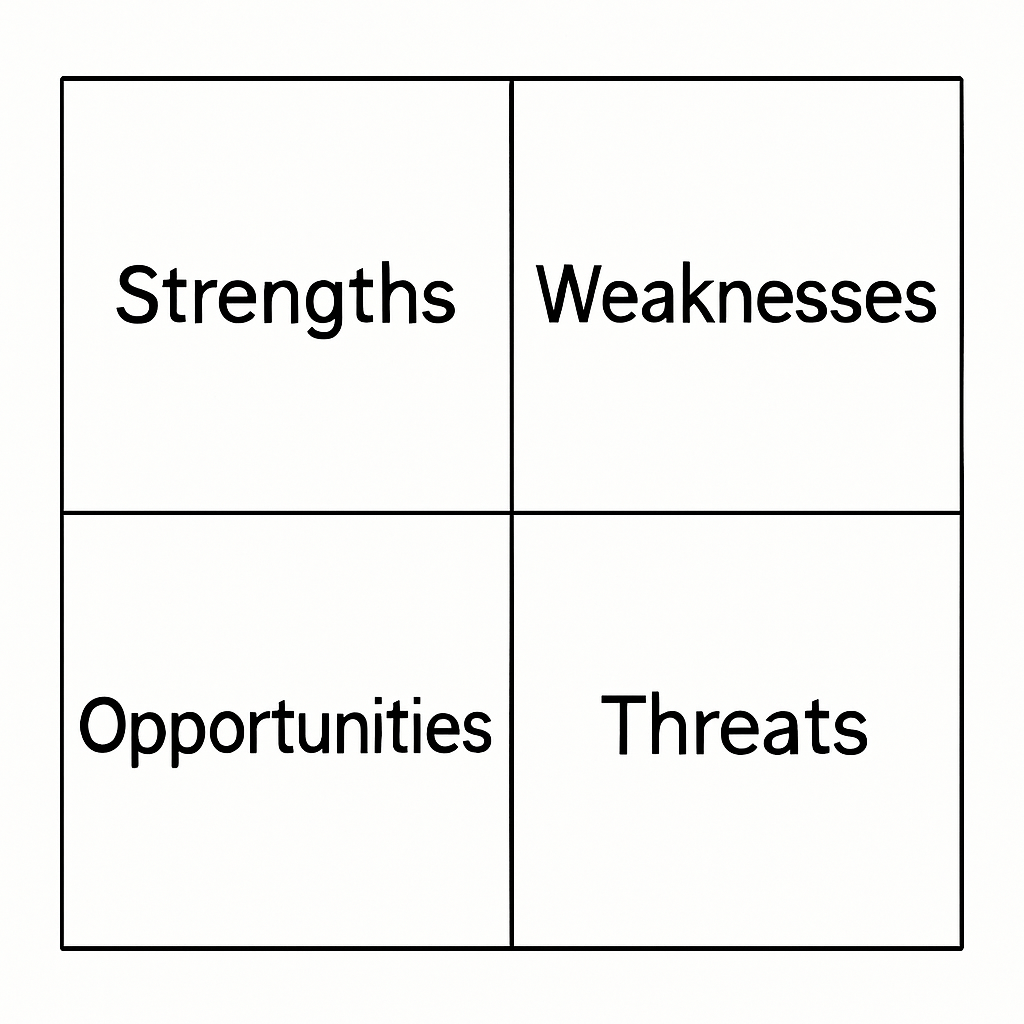
Now that you have a destination (your vision), you need to find your “You Are Here” dot on the map. A surprisingly simple tool called a SWOT analysis is perfect for this. It’s a quick snapshot of your current situation, and it’s a cornerstone of effective strategic planning that gives you a realistic look at the road ahead. SWOT simply stands for Strengths, Weaknesses, Opportunities, and Threats.
To get started, just grab a piece of paper and divide it into four squares. Then, spend a few minutes jotting down answers to these four straightforward questions:
- Strengths: What are you great at internally? (e.g., amazing customer service, a unique product)
- Weaknesses: Where do you need to improve internally? (e.g., an outdated website, a hidden location)
- Opportunities: What’s happening outside your business that you could take advantage of? (e.g., a new local event, a growing market trend)
- Threats: What outside forces could harm you? (e.g., a new competitor, rising supply costs)
For example, a freelance graphic designer’s Strength might be their “expertise in logo design,” while a Weakness is “inconsistent monthly income.” An Opportunity could be that “local businesses are looking to rebrand,” and a Threat might be “new AI tools that create free logos.” For an even better analysis, ask a trusted client or mentor for their opinion—sometimes others see things we miss.
Looking at these four areas together provides incredible clarity. You now have a realistic picture of the advantages you can lean on and the challenges you need to navigate. This analysis isn’t just a list; it’s the raw material for your next step. You’ll use it to build a bridge from where you are today to the vision you’ve set for your future.
Step 3: Set 3-5 Powerful SMART Goals
Your SWOT analysis gave you a realistic starting point, and your vision gave you a destination. Now, it’s time to build the actual road that connects them. This is where you translate your big-picture thinking into a handful of major goals—think 3 to 5 at most. Having too many goals is like trying to chase five rabbits at once; you end up catching none. A focused plan channels all your energy toward what truly matters.
The best way to do this is by setting SMART goals for your strategy. This simple framework turns a vague wish into a real target. A SMART goal is Specific, Measurable, Achievable, Relevant, and Time-bound. Instead of saying, “I want more customers,” a SMART goal sounds like, “I will gain 50 new email subscribers (Specific, Measurable) by promoting my newsletter on social media (Achievable, Relevant) over the next three months (Time-bound).”
This process is most powerful when you link your goals directly to your SWOT analysis. For example, our freelance designer noted a Weakness of “inconsistent monthly income” and an Opportunity that “local businesses are looking to rebrand.” A perfect SMART goal would be: “Secure three new local business clients for rebranding projects by the end of the second quarter.” This goal directly tackles a weakness by seizing an opportunity.
These 3-5 goals become your north star for the year. They are your primary focus areas and provide the clarity you need to make decisions. Every new idea or distraction can be measured against them: “Does this help me achieve one of my core goals?” With these targets defined, you now have clear indicators for success. The next step is to break down each of these big goals into the small, weekly tasks that will make them happen.
Step 4: Create a 90-Day Action Plan
Those big, ambitious goals you just set can feel intimidating. The secret to achieving them isn’t a single, heroic effort; it’s a series of small, consistent steps. This is your action plan—the part of your strategy that answers the question, “What should I be working on this week?” If your strategic goal is the destination, your action plan is the turn-by-turn GPS navigation that gets you there. This is how you successfully implement a strategic plan, by translating your “what” into a concrete “how.”
For each of your 3-5 SMART goals, create a short list of specific tasks with deadlines. Think in 90-day sprints, which makes planning feel far more manageable. This list becomes your simple strategic plan template for getting things done. For example, if one of your goals is to “Land 2 new freelance clients in Q3,” your action plan might look like this:
- Goal: Land 2 new freelance clients in Q3.
- Action: Update online portfolio with 2 new case studies (By July 15).
- Action: Email 5 old clients asking for referrals (By July 20).
- Action: Spend 30 mins on LinkedIn researching and contacting 5 ideal clients every Monday.
With an action plan, a huge goal like “get more clients” is no longer a source of anxiety. It’s a clear checklist that gives you focus and momentum. This is the difference between being busy and being productive. But what happens when things change? A new opportunity pops up, or a task takes longer than expected. A great plan isn’t meant to be carved in stone; it’s a living document. That’s why the final step is to treat your strategy like a garden, not a sculpture.
Step 5: Review and Adapt Every 90 Days
Your new strategic plan isn’t a fragile sculpture, meant to be perfected once and then admired from a distance. Think of it as a living garden. The world changes, seasons turn, and unexpected storms roll through. A good gardener doesn’t abandon their plan when a plant wilts; they adapt by watering, weeding, and adjusting to the conditions. Your strategy needs the same kind of ongoing care to flourish.
This doesn’t require endless meetings. To keep your plan on track, you only need one simple 30-minute check-in every 90 days. Pour a cup of coffee and ask yourself three questions: What progress have we made toward our goals? What got in our way or didn’t work as expected? And based on that, what is our most important focus for the next 90 days? This simple rhythm is the key to keeping your strategy effective over the long run.
Ultimately, this process prevents one of the most common strategic planning mistakes: creating a rigid plan that shatters the moment it meets reality. By reviewing and adjusting, you’re not failing; you’re learning and steering. Your plan stops being a set of restrictive rules and becomes what it was always meant to be—a reliable compass that helps you navigate toward your vision, no matter which way the wind blows.
Your Roadmap to a Clearer Future
You now have a clear roadmap to trade uncertainty for purposeful action. Building a strategic plan isn’t about creating a stuffy document; it’s about giving yourself clarity and confidence. The process is a simple journey: set your destination (Vision), find your starting point (SWOT), choose your route (Goals), write the turn-by-turn directions (Action Plan), and adjust as you go. You have everything you need to begin.
So grab a notebook and start with the first step: defining why you’re on this journey in the first place.