
How to Draft a Strategic Plan: A Step-by-Step Guide
Do you ever end your week feeling exhausted, knowing you were busy every moment, but aren’t sure if you actually moved closer to your biggest goals? It’s a common feeling, like you’re spinning your wheels. A strategic plan is the tool that stops the spinning. You wouldn’t start a cross-country road trip without a map, and a strategic plan is that roadmap for your business, project, or career.
It’s not a stuffy corporate document; it’s a simple guide that ensures everything you do, every single day, is taking you exactly where you want to go. This tool replaces the feeling of being constantly reactive with the quiet confidence of being proactive. And it’s not just for Fortune 500 companies; it’s for the local bakery, the freelance designer, and the community group that wants to make a real impact. This process will give you a clear, actionable guide to turn your ambitions into reality.
Strategic Plan vs. Business Plan: What’s the Difference and Which Do You Need First?
As you start, you might wonder how a strategic plan differs from a business plan. They’re often confused, but the distinction is simple and crucial. Your strategic plan is the map—it defines your ultimate destination (your vision) and the main reason for your journey (your mission). It focuses on the big-picture “what” and “why” over the next three to five years.
A business plan, on the other hand, details the vehicle and logistics for that journey. This document outlines the “how”: the specific operational details, marketing tactics, financial projections, and team structure needed to move forward. It’s a more granular, short-term document, often covering a single year.
The strategic plan must always come first. You can’t effectively choose the right car or budget for gas until you know whether you’re driving to the mountains or the coast. By setting your long-term direction, you create the guidepost that all your future operational and business plans will follow.
Step 1: Define Your Destination with a Clear Mission and Vision Statement
Every great journey starts with a destination in mind. In strategic planning, that destination is defined by two critical statements: your Vision and your Mission. Developing these isn’t a complex corporate exercise; it’s about giving your work a clear purpose that guides every decision you make.
Think of your Vision Statement as your North Star. It’s the big, inspiring, and somewhat audacious dream of what the world will look like in 5-10 years if your organization is wildly successful. It should be boiled down to a single, powerful sentence. For a small community garden, a Vision might be: “A neighborhood where every family has access to fresh, healthy food.” It’s the ultimate destination on your map.
In contrast, your Mission Statement describes the “how” of your daily journey. It’s your practical purpose, explaining what you do, who you do it for, and the value you provide right now. It is grounded, present-focused, and actionable. That same community garden’s Mission could be: “To manage a shared, organic garden that provides affordable produce and gardening education for our local residents.”
Together, these statements provide direction and focus. Your Vision is the why that inspires you, while your Mission is the what that guides you. With your destination set, it’s time to get a clear picture of your starting point by understanding your unique strengths and weaknesses.
Step 2: Run a 30-Minute SWOT Analysis to Find Your Hidden Advantages
Now that you know your destination, you need to figure out exactly where you are on the map. The quickest way is with a SWOT analysis. It’s a 30-minute brainstorming exercise that gives you a realistic, 360-degree view of your current situation—a quick environmental scan to assess the terrain before you start your journey.
To begin, grab a piece of paper and draw a large box with four quadrants. SWOT stands for Strengths, Weaknesses, Opportunities, and Threats. The top two are internal (things you can control), while the bottom two are external (things happening in the world around you).
- Strengths (Internal, Positive): What do you do exceptionally well? What unique resources or advantages do you have? (Example: A passionate team, a great reputation.)
- Weaknesses (Internal, Negative): Where could you improve? What are you missing or what holds you back? (Example: An outdated website, limited budget.)
- Opportunities (External, Positive): What trends or market changes can you take advantage of? (Example: A new neighborhood event, growing interest in local products.)
- Threats (External, Negative): What obstacles or competition do you face? (Example: A new competitor opening nearby, rising supply costs.)
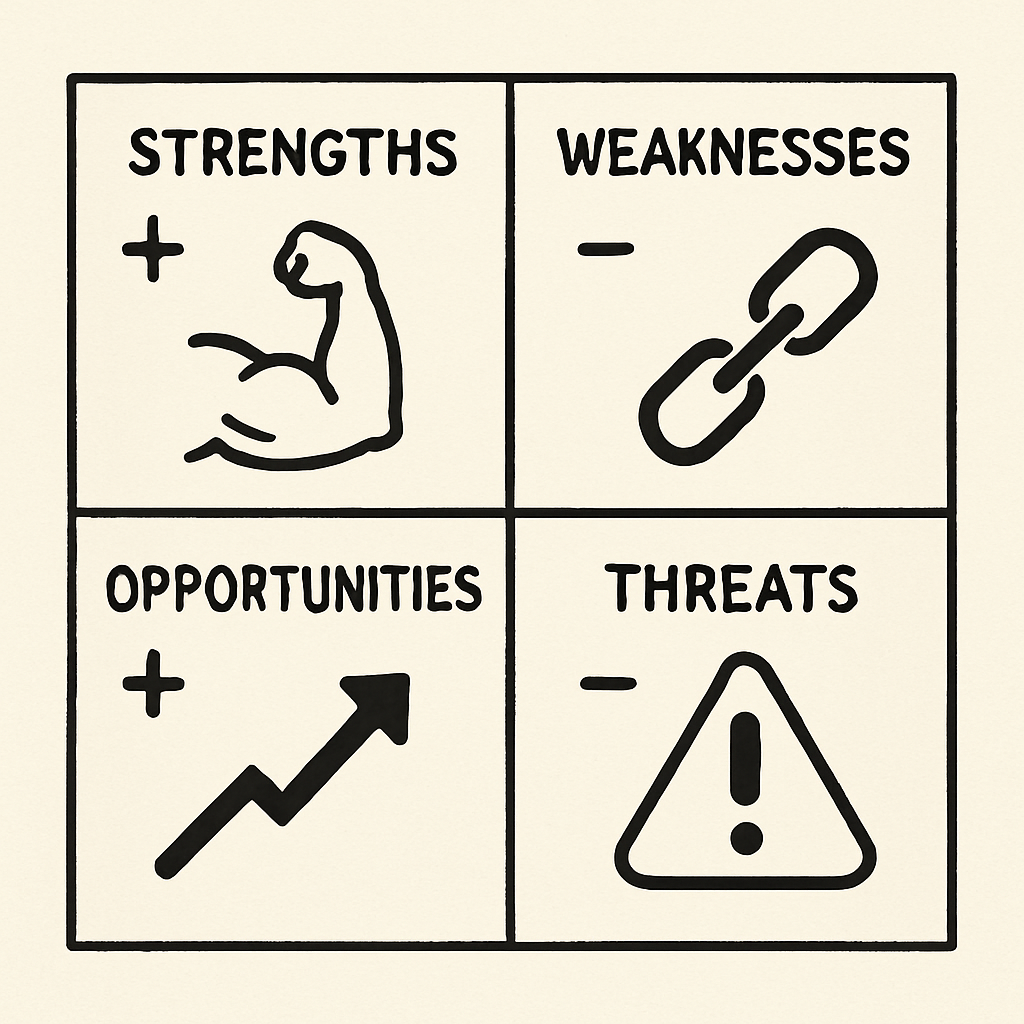
The real power of this analysis comes from connecting the dots. For instance, a great strategy for business growth is finding a way to use a Strength to seize an Opportunity. If our community garden’s Strength is having passionate, expert volunteers, and an Opportunity is a new local farmers market, a clear strategy emerges: use those volunteers to run a stall at the market.
With this clear picture of your advantages and challenges, you’ve identified the most promising areas to focus your energy. The next step is to translate these broad ideas into specific, actionable targets.
Step 3: Turn Vague Ideas into Actionable Targets with SMART Goals
Your SWOT analysis likely uncovered promising ideas like “improve our marketing” or “build a stronger team.” These are too fuzzy to act on. A plan built on vague wishes is a recipe for feeling busy but getting nowhere. Turning your vision into reality requires setting SMART goals.
To give your goals real power, make them SMART. Run each goal through this five-point checklist to transform a weak idea into a strong, trackable target:
- Specific: Be crystal clear. What exactly do you want to accomplish?
- Measurable: Include a number. How will you know you’ve succeeded?
- Achievable: Be realistic. Is this goal possible with your current resources?
- Relevant: Ensure it matters. Does this target support your overall mission?
- Time-bound: Set a deadline. When will this goal be complete?
Let’s see this in action. An idea from your SWOT might be to use an Opportunity like “growing interest in local products.” A vague goal would be: “Sell more locally.” Instead, a SMART goal is: “Increase sales from our in-store ‘Local Favorites’ section by 25% by the end of the third quarter.” These concrete targets are vital components of a strategic planbecause they give you a finish line to run toward. Now, it’s time to connect them to your day-to-day work.
Step 4: Create a Simple Action Plan to Connect Your Goals to Daily Tasks
A powerful SMART goal is a fantastic milestone, but it’s not the starting line for your daily work. Staring at a goal like “Increase sales by 25%” can still feel overwhelming. Bridge the gap between your big-picture strategy and your day-to-day efforts with a simple action plan. This is where you break down what you want to achieve into the small, concrete steps of how you will do it.
To build your action plan, take each SMART goal and brainstorm all the individual tasks required to reach it. For the goal of increasing sales in your “Local Favorites” section, your tasks might include: “Design new in-store signage,” “Launch a 3-week social media campaign featuring local suppliers,” and “Train staff to mention the section to customers.” When creating an operational action plan, every single task must have a person responsible for it (even if it’s just you) and a firm completion date.
This process transforms your plan from a document that gathers dust into a living to-do list that guides your weekly priorities. You’ll no longer wonder if you’re working on the right things; your action plan gives you a clear checklist for progress. As you start checking off these tasks, you’ll need a way to measure if your efforts are paying off.
Step 5: Choose Key Performance Indicators (KPIs) to Check If You’re on Track
As you check off tasks from your action plan, how do you know if your efforts are moving the needle? You need a simple way to measure progress without getting buried in spreadsheets by defining key performance indicators (KPIs). A KPI is like your car’s dashboard. You don’t need to watch every dial; you just glance at the speedometer and fuel gauge to know if you’re on track.
A KPI isn’t the same as your goal. A goal is the destination, like “Increase customer email sign-ups by 500 people this quarter.” Your KPI is the live, frequent measurement that shows you’re heading in the right direction. For that goal, a great KPI would be “Number of new email subscribers per week.” It’s the pulse of your progress.
When selecting KPIs, less is more. For each major goal, choose just one or two metrics that give you the clearest and quickest signal of success. Drowning in data is a common reason people abandon their plans. Focusing on a few vital numbers gives you clarity, not confusion. With your goals, actions, and KPIs in place, your strategic plan is a powerful tool for focused work.
3 Common Mistakes That Will Silently Kill Your Strategic Plan
You’ve done the hard work of building a plan with clear goals and metrics. Now you must avoid a few common mistakes that can quietly sabotage your efforts, turning your powerful new map into a forgotten document.
The first mistake is creating a plan that’s too long and complicated. It’s tempting to create a beautiful, 30-page document, but the reality is that no one will read it—including you. A simple, one-page summary that you can look at every week is infinitely more powerful than a perfect plan that never sees the light of day.
Another fatal error is treating your plan as a secret document that you “set and forget.” For a plan to work, it needs to be shared and discussed. Communicating the strategic vision means ensuring everyone on your team knows the destination and how their work contributes. Furthermore, your plan isn’t a stone tablet; it’s a living guide. Review it regularly—perhaps monthly or quarterly—to check your KPIs, celebrate wins, and adjust your course as needed. This is how to successfully implement a strategic plan.
Your Strategic Plan is Drafted: Here’s What to Do Next
You no longer have to guess what comes next. Where you once felt busy but not productive, you now hold a roadmap. You’ve built your own by choosing your destination (Vision), checking your starting point (SWOT), planning your major stops (Goals), and building the dashboard (KPIs) to track the journey. You have successfully traded guesswork for direction.
Remember, this map is a guide, not a rigid script. The best plans are living documents, meant to be revisited and adjusted. As conditions on the ground change, you can update your route without ever losing sight of your ultimate destination. This approach turns a static plan into a dynamic tool that creates real momentum.
The most important step isn’t perfecting the plan; it’s starting it. To get started right now, take just 15 minutes to define your destination. Write down that inspiring Vision for what you hope to build. The journey of a thousand miles begins not with a single step, but with knowing where you’re going.