
Strategies to Overcome the Frozen Middle
Have you ever sat in a company meeting where a leader announced an exciting new goal—like becoming “the most innovative in our field!”—only to return to your desk with absolutely no idea what you’re supposed to do differently? If so, you’ve witnessed the “frozen middle” in action. It’s the invisible wall where big ideas go to die and a primary reason why corporate strategy fails in execution. This isn’t a personal failing, but a common, structural problem.
The breakdown works like a bad game of telephone. A clear message starts at the top but stops moving altogether in the middle. This is the frozen middle management phenomenon: the critical layer where high-level strategy fails to be translated into concrete, frontline action. This failure creates what’s known as an “execution gap”—the vast, empty space between a company’s great idea and its ability to actually get it done.
Consider a retail chain whose headquarters declares a goal to “enhance the customer experience.” Without a clear plan, what is the role of middle management in this strategy? They can’t give specific guidance, so cashiers and floor staff change nothing. The initiative stalls, time is wasted, and employees grow cynical. Thawing this frozen layer starts with understanding why it forms.
Caught in the Squeeze: Why Middle Managers Burn Out
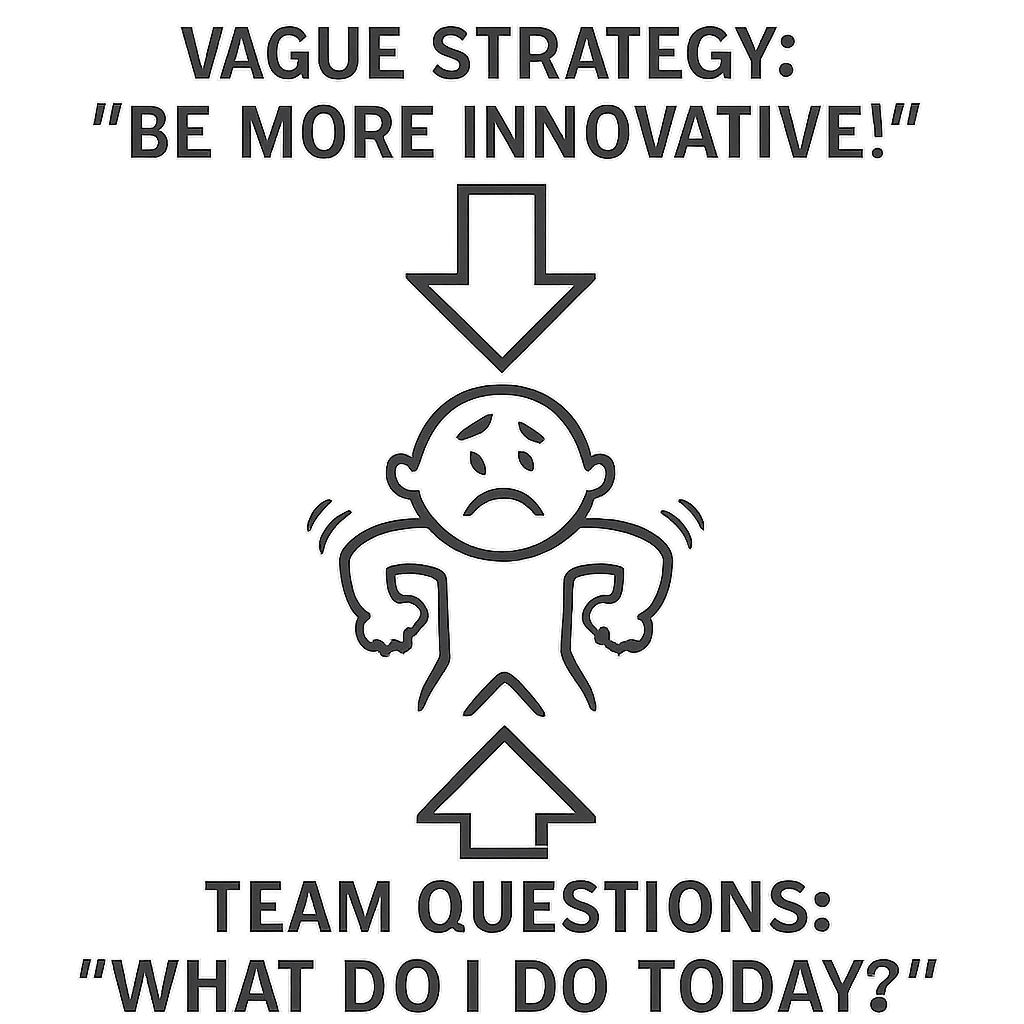
So, if the “frozen middle” is the problem, what’s the cause? It’s rarely about a manager’s lack of skill or motivation. Instead, they are often caught in a powerful and demoralizing squeeze, trapped between two conflicting forces. This pressure-cooker environment is the primary reason that good intentions and brilliant strategies so often grind to a halt.
From above comes the pressure of big-picture, often vague, strategy. A leader might announce an exciting new direction like, “We need to become the most customer-centric company in our industry!” While inspiring, this doesn’t tell a manager what to do differently on a Tuesday morning. It’s a destination without a map.
At the same time, pressure builds from below. The manager’s team members need and deserve clear, concrete answers to get their work done. They ask practical questions: “Should I stop working on Project A to do this?” “What does ‘customer-centric’ mean for my software update?” “How will we know if we’re succeeding?”
Faced with translating a fuzzy vision into a concrete plan with no support, the manager is paralyzed. They can’t answer their team’s questions, so communication stops. They burn out trying to bridge an impossible gap, and the strategy freezes in place, stuck in the middle. This is the moment when an organization’s great ideas quietly fade away.
The ‘Why-What-How’ Framework: A Simple Tool to Melt the Ice
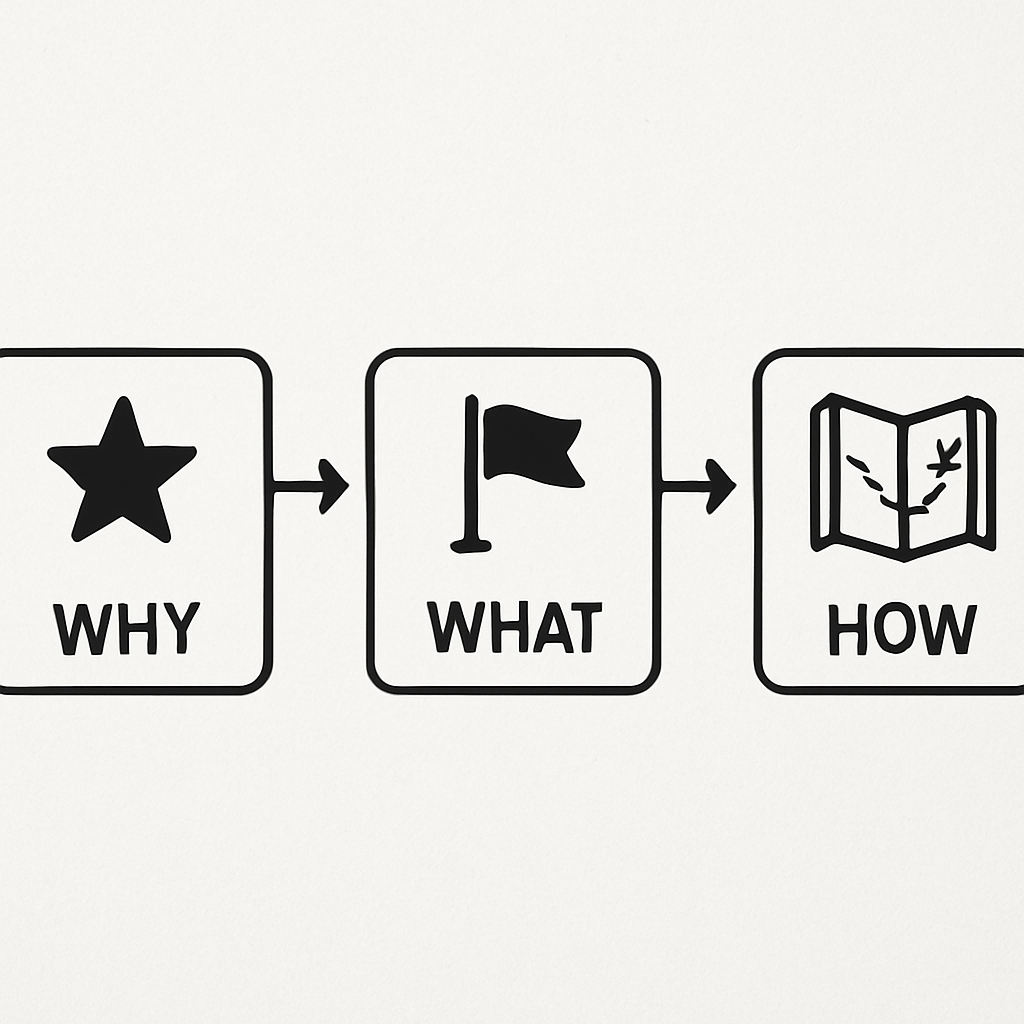
Breaking this paralyzing cycle doesn’t require a business degree or complex spreadsheets. It requires a simple, repeatable method for turning a vague idea into a clear plan. This is the core job of a manager: to be a translator, not just a messenger. The most effective way to do this is with the ‘Why-What-How’ framework, a straightforward tool for turning high-level goals into meaningful action and melting the ice of the frozen middle.
The framework provides a clear path by answering three sequential questions, ensuring that strategy successfully makes the journey from the executive suite to the team on the ground.
- Find the ‘Why’: Connect the task to the big-picture purpose. (The North Star)
- Define the ‘What’: Translate the big-picture ‘why’ into a clear, specific outcome. (The Destination)
- Draw the ‘How’: Break the outcome into concrete steps the team can execute. (The Map)
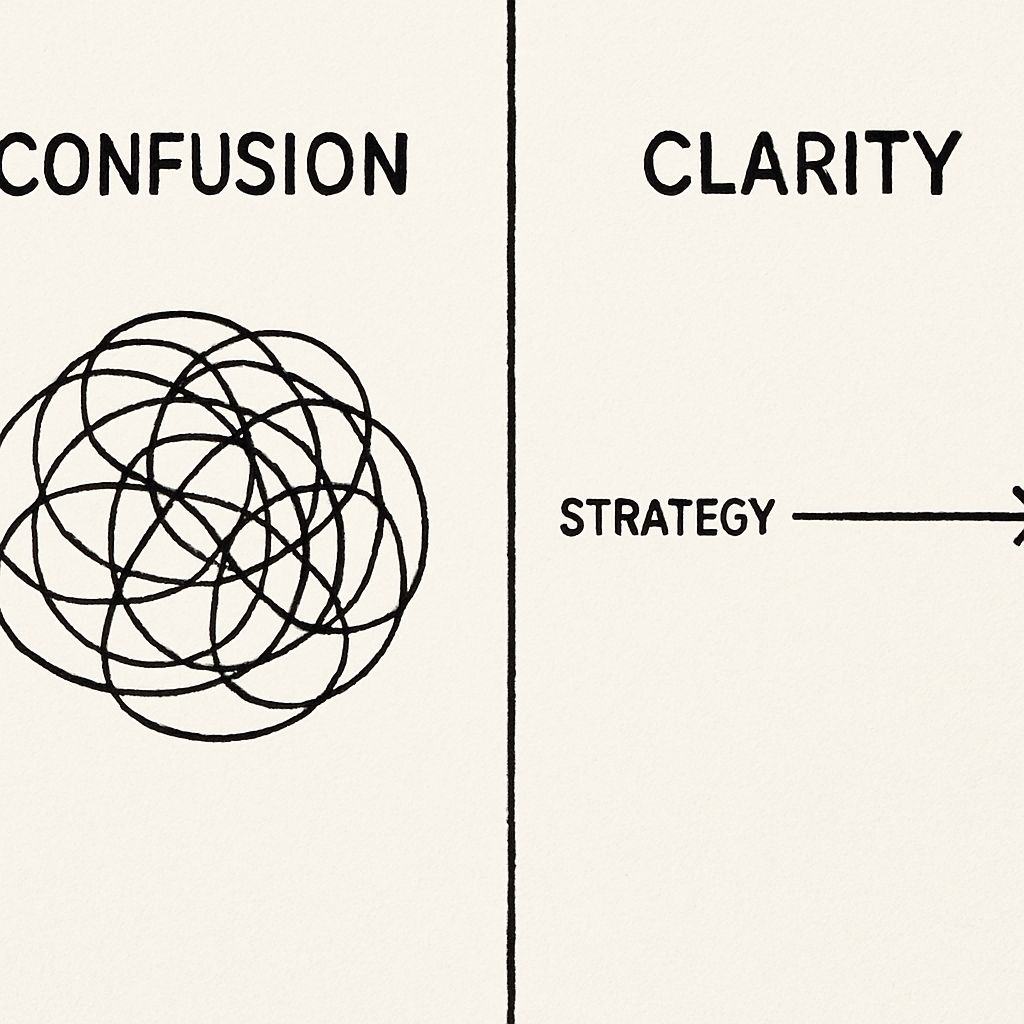
Instead of passing down confusion, a manager using this approach delivers clarity. Everyone understands not just what they need to do, but why it matters. This process transforms a fuzzy vision from leadership into an actionable project your team can get behind.
Step 1: Find the ‘Why’ to Give Your Team a North Star
It all begins when a vague goal lands on your desk. Your boss might say, “We need to increase customer engagement this quarter.” A typical manager might pass that order along, creating immediate confusion. An effective manager, however, asks a simple but powerful question: “Why?” This isn’t about being difficult; it’s about uncovering the strategic intent. The goal isn’t just to make a number go up. Your job is to find the story behind that number, which is the first, most crucial step in achieving real organizational alignment.
Once you have the answer—perhaps “because our most engaged customers are the ones who stick with us the longest”—your role as a translator begins. You don’t just repeat the corporate-speak. You reframe it into a mission your team can feel. Instead of saying, “Management wants more engagement,” you say, “Our focus this quarter is to become so essential to our customers that they wouldn’t dream of leaving us.” This single shift transforms a sterile objective into a shared purpose, a North Star to guide your team’s efforts.
Without this guiding principle, work becomes a disconnected series of tasks. A clear ‘Why’ provides motivation and a filter for every decision the team makes. It answers the question, “Does this action help us become more essential to our customers?” With that purpose established, you’ve laid the foundation. But a North Star only tells you which direction to head; it doesn’t tell you where you’re actually going. For that, you need to define a clear destination.
Step 2: Define the ‘What’ by Making the Goal a Real Destination
Knowing your ‘Why’ gives your team a direction, but it’s like pointing north without picking a city to visit. To make progress feel real, you have to define a specific destination: the ‘What.’ This is the most common place where a great mission dies from abstraction. Your job as a manager is to prevent that by translating the inspirational ‘Why’ into a concrete outcome that your team can see, touch, and build toward. Without a clear outcome, a team is left adrift.
The most effective way to do this is by asking one simple question: “What will exist when we’re done that doesn’t exist now?” For the mission to “become essential to our customers,” the answer isn’t a feeling; it’s a thing. After a discussion with your team, you might land on a tangible ‘What’: “We will launch a new dashboard by the end of the quarter that shows customers exactly how much money they’ve saved using our product.” This simple act transforms the abstract goal into a specific, time-bound project.
Defining a clear ‘What’ gives your team an achievable finish line and is a cornerstone of execution excellence. It replaces the anxiety of an endless, vague task with the focus of a tangible goal. Everyone now knows exactly what they are working to create, which fosters a powerful sense of shared ownership and progress. But a destination is only part of the puzzle; you still need a map to get there.
Step 3: Draw the ‘How’ by Creating a Shared Action Plan
With a clear destination set, the final step is to draw the map your team will follow. This is the ‘How’—the series of concrete actions that turn your objective into reality. Critically, this isn’t a map you draw alone and hand down. The most effective way to translate strategy into an action plan is to create it with your team. They are the experts on the ground who know the terrain, see potential roadblocks you can’t, and can estimate what’s truly possible. Involving them in tactical planning doesn’t just create a better plan; it builds unshakable ownership.
Gather your team and ask, “What are the exact steps to get this done?” For the goal of launching a new savings dashboard, the discussion naturally breaks the large project into manageable pieces with clear owners. The output isn’t a complex chart, but a simple, shared to-do list that looks something like this:
- Weeks 1-2: Jane researches and finalizes the key savings metrics to display.
- Weeks 3-4: Tom builds the backend logic to pull the customer data.
- Week 5: Maria designs the user interface for the dashboard.
- Regular Check-ins: We’ll have a 15-minute sync every Monday to share progress.
Suddenly, a big, intimidating goal becomes a straightforward sequence of tasks. This process demystifies the work, making it obvious how each person’s contribution connects to the larger outcome. This is the heart of execution excellence: everyone knows what to do, why it matters, and how their piece fits into the puzzle.
The Real Payoff: More Than Just Finishing Projects
The payoff of this clarity is a direct antidote to burnout. Most workplace frustration isn’t from hard work, but from work that feels pointless. When employees don’t understand the ‘Why’ behind their tasks, their motivation withers and their effort feels wasted. By translating strategy into meaningful purpose, you replace the disengaged feeling of “just doing a job” with the powerful drive of being part of a shared mission.
This clarity also unlocks a powerful sense of ownership. Once your team understands the ‘What’—the destination—you no longer need to micromanage the journey. This empowers them to use their skills to navigate challenges and find the best path. Instead of constantly asking for directions, they become proactive problem-solvers. This shift transforms their role from a constant supervisor into a trusted coach.
Ultimately, an engaged and empowered team delivers better business results. When everyone pulls in the same direction, the strategy-execution gap closes. This deep organizational alignment means less time wasted on confusing priorities and more energy focused on work that moves the needle. Goals are met more consistently, and the company becomes more effective. This isn’t just a morale boost; it’s a competitive advantage.
Your First Step: How to Start Thawing the Middle Today
A vague executive goal is no longer a frustrating problem to endure, but a translation failure you can fix. The “frozen middle” isn’t a personal failing but a systemic breakdown, and the Why-What-How framework is the tool to bridge the gap between a lofty vision and the concrete work your team does every day.
You don’t need to overhaul everything overnight. For your first success, pick just one goal your team is working on. In your next meeting, simply ask: “Let’s pause and make sure we all agree on the ‘Why’ behind this.” That single conversation is your first step toward better leadership communication and melting the ice.
This is how your role transforms. You are no longer just a messenger of confusing directives, but a creator of clarity and purpose. By translating strategy into action, you’re not just managing tasks; you’re empowering your team by connecting their daily efforts to what truly matters.